Rectangle
History Integrate Network

History

The Integrate Network was initially brought into life in 2016 by the German Federal Minister for Food and Agriculture, Christian Schmidt, and his Czech colleague, Marian Jurečka (see link on the left for Prague Declaration), and subsequently supported by the European Commission’s Standing Forestry Committee. In May 2022, the Integrate Network became the Integrate Network Multi-Donor Trust Fund.


Former projects

Integrate Finland

The main goal of the project was to develop the skills of forest owners in North Karelia and to support the decision-making capabilities of forest owners by developing a learning and training framework to support decision-making related to forest use. In this context (1) educational forests were established in North Karelia to train forest owners in forest management, taking into account the multifunctional use of forests, issues of sustainable cultivation, climate change and carbon sequestration, and to promote international exchange, (2) the existing I+ mobile application was improved and further developed to enable forest owners to assess the impact of forest management decisions on timber production, biodiversity and climate change mitigation, and (3) teaching materials were developed for implementing training in the established educational forests sites North Karelia.

Integrate Finland

ANW “Dauerwald” Projekt

Main objective of responsible forest management is to reduce the risk of forest loss over large areas while at the same time safeguarding yield potential. To investigate the economic and ecological sustainability of applying close to nature forest management, the project “Dauerwald” set up permanent observation plots and marteloscopes in selected forest enterprises in different regions of Germany as part of a larger European network. 

ANW “Dauerwald” Projekt

FoReSite (2020-2022)

FoReSite targeted to develop the Networks’ strategic profile as a nucleus for topics around integrative forest management and most importantly seek options for continuing its work in the future by securing financial support. It emphasized the need for cross-discipline, cross-sector and multi-actor exchange for addressing sensitive issues when managing forests for multiple services based on varying demands especially by organising a series of webinars, publications and policy briefs. Another important activity was to continue the support of the expansion of the demonstration site network and the corresponding training software. Demonstration sites have shown to be highly appreciated as training nd education tools for better understanding rationales, effects and trade-offs when implementing integrative forest management measures. FoReSite was funded by German Federal Ministry of Food and Agriculture.

FoReSite (2020-2022)

INFORMAR (2017-2020)

It was considered crucial to preserve the knowledge gained by Integrate and Integrate+ and to maintain and expand the network of forest policy experts and forest practitioners. The project Integrated Forest Management Learning Architecture (INFORMAR) did precisely that. Apart from managing the European Network Integrate and the Integrate Practice Network, the third focus of INFORMAR lied on research on integrative forest management approaches on a European scale. It analyzed existing knowledge relating to the implementation of integrative forest management in order to address and fill potential knowledge gaps. INFORMAR was funded by German Federal Ministry of Food and Agriculture.

INFORMAR (2017-2020)

Integrate+ (2013-2016)

Integrate+. This was a demonstration project funded by German Federal Ministry of Food and Agriculture aiming at establishing a European network of demonstration sites for the integration of biodiversity conservation into forest management. It was built on a growing network of forest practitioners and research partners focussing on the implementation of integrative management and enhancing transnational exchange of experiences. The main outcomes of this project were the set-up of the Marteloscope network, the creation of the Catalogue of Tree Microhabitats and, as icing on the cake, the award-nominated film Wise use of our forest: the integrative approach.

Integrate+ (2013-2016)

Integrate (2010-2013)

Focusing on the Integration of Nature Protection in Forest Management and its Relation to other Forest Functions & Services. The geographic scope of the project was primarily the Central European region. Integrate gave science-based input to the discussion on the topic of ‘protection through management’ in the forest sector. This resulted in a set of country reports and a peer review paper. The work was financially supported by the Baden-Württemberg Ministry of Rural Affairs and Consumer Protection. The next activity, funded by the Federal Ministry of Food, Agriculture and Consumer Protection (BMEL) was the elaboration of the book Integrative approaches as an opportunity for the conservation of forest biodiversity  (2011 – 2013). It constitutes a comprehensive assessment of the latest scientific knowledge on biodiversity in managed and unmanaged forests. It aimed at providing a basis for discussion by informing the ongoing debate on how biodiversity can be best preserved in commercially managed forests in Central Europe and beyond. The book is also available in English, German and French and reprinted several times. Financial contributions to the printing of the book were received from the Swiss Federal Institute for Forest, Snow and Landscape Research (WSL), the Baden-Württemberg Ministry of Rural Affairs and Consumer Protection, the French Ministry of Agriculture, Food and Forestry and the Swiss Canton Vaud.

Integrate (2010-2013)

What is the Integrate Network?

The Integrate Network Multi-Donor Trust Fund – short: Integrate Network – is an alliance of representatives of different European countries that promotes the integration of nature conservation into sustainable forest management at the policy, practice and research level. Forest management challenges related to nature conservation are rather similar across Europe. The Integrate Network promotes the exchange of successful management practices and experiences amongst its Members. The European Forest Institute (EFI) accompanies the process in its role as secretariat and by gathering scientific and practical evidence on the successful application, training, and communication of integrative forest management approaches.

Who are we?

The Integrate Network, established in 2016 (Prague Declaration), is an alliance of representatives of 19 European countries that promotes the integration of biodiversity into forest management.

Each country provides a national focal point who is responsible for sharing information from the country. The Network is chaired in rotation by one of its members for one year.

Since 2022, the Network operates as a Multi-Donor Trust Fund. As the Networks’ secretariat, the European Forest Institute assists in gathering scientific and practical evidence on the application of integrative forest management. It facilitates training and provides communication support for network members and relevant stakeholders.
Infographic practice research and policy making
Rectangle
Marteloscope Students Bonn Day11

What we do?

  • We promote cross-sectoral and cross-country learning and cooperation on successful approaches for enhancing biodiversity conservation as an integral part of forest management practices.
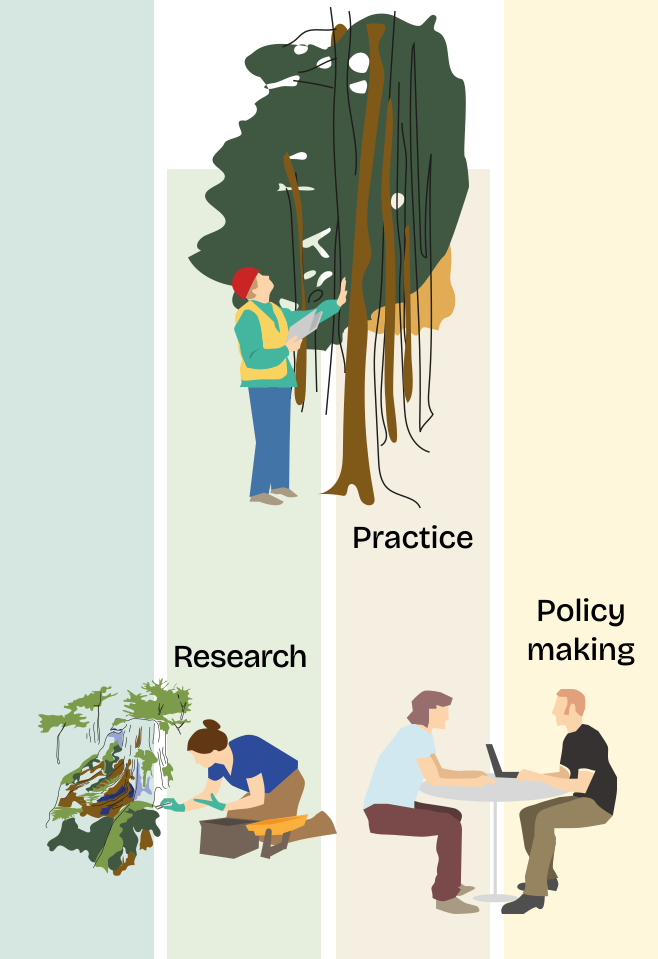
  • We act as an open, pro-active interface at the triangle of research, policy and practice.
  • We facilitate the exchange of successful management practices and experiences among Integrate Members and beyond.
  • We gather scientific and practical evidence on the successful application, training, and communication of integrative forest management.
  • We provide a platform in events and onsite in the forest for discussion on balancing demands of nature conservation and other forest functions and services.
  • We maintain a network of ca. 200 demonstration and learning sites in more than 20 European countries, consisting of a broad diversity of forest types and ownership structures.