Establishing a Network of Marteloscopes in Western Ukraine
Guest article by Vasyl Lavnyy and Peter Spathelf, originally written in German and published here.
One of the central tasks of forest management is deciding when, where, and what kinds of interventions are needed in a forest. But what factors should influence those decisions?
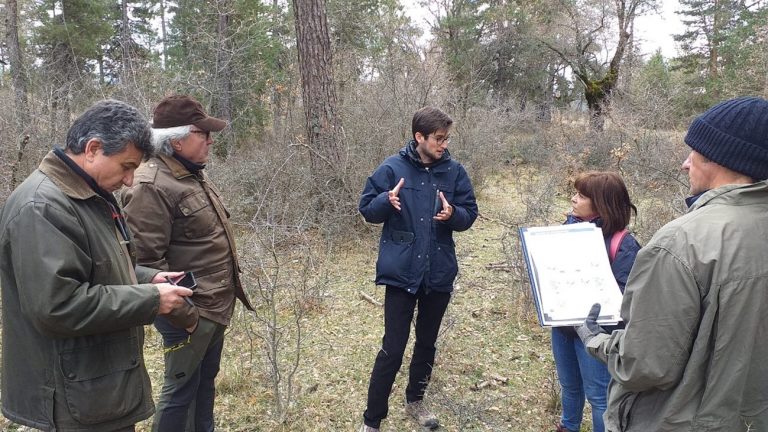
Participants of forestry workshops often bring very different goals, motivations, and levels of experience to this question. Because of that, it is important to ask how silvicultural interventions affect various ecosystem services and the biological diversity of the forest. Marteloscopes are particularly useful for this purpose, because they allow users to make virtual interventions and immediately discuss the outcomes while standing in the forest.
Marteloscopes aren’t just valuable for people with a solid forestry background – they are also excellent tools for students and other groups interested in forests.
Over the last 20 years, Prof. Vasyl Lavnyy, Professor at the Ukrainian National Forestry University, has led many field trips through Ukrainian primary forests for foreign researchers and foresters from Germany, Switzerland, and France.
During these joint excursions and conversations, he learned about the European Forest Institute’s Integrate+ project, “Establishing a European Network of Demonstration Sites for Integrating Biodiversity Conservation into Forestry,” which was funded by the German Federal Ministry of Food and Agriculture (BMEL). This topic still is highly relevant for Ukraine, which is actively working to introduce sustainable, multifunctional forest management. In 2017, Prof. Lavnyy also translated the microhabitat catalogue into Ukrainian.
The Ukrainian National Forestry University participates in many collaborative research projects with foreign universities and research institutes, and its closest partner in forestry research is the Eberswalde University for Sustainable Development. Professors Vasyl Lavnyy and Peter Spathelf lead this partnership. Besides teaching and publishing together, they have also created several demonstration areas for close-to-nature forestry in western Ukraine.
These demonstration plots were established in stands dominated by the main tree species in Ukraine – pine forests (about 35% of the country’s forest area), oak forests (about 28%), and beech forests (about 9%). Another important criterion was proximity to federal roads near Lviv so that students and staff of the Lviv forestry operation could easily reach them.
Seven marteloscopes in detail
The first two marteloscopes in Ukraine were set up in 2020 as part of the international scientific project “Resilpine – Conversion of Pine Forests to Close-to-Nature Forestry in Ukraine with Special Consideration of Resilience to Fire and Weather Extremes such as Drought, following the Principles of Integrated Fire Management (2020–2022).” This project was funded by the BMEL and led by Prof. Peter Spathelf from the Eberswalde University for Sustainable Development.

The first marteloscope is located in a 75-year-old mixed pine stand in the Lapajiwka Forest District of the Lviv forestry operation. Detailed stand characteristics are shown in Table 1 below. The average tree height is 27.6 m, the mean diameter at breast height (DBH) is 37.2 cm, and the stocking rate is 0.82.
| Species | Number of Trees (pcs) | Basal Area (m²) | Avg. Height (m) | Avg. DBH (cm) | Volume (m³) | % of Total Stand Volume |
|---|---|---|---|---|---|---|
| Pinus sylvestris | 186 | 22.6839 | 29.3 | 39.4 | 313.7 | 57.3 |
| Tilia cordata | 102 | 5.6580 | 22.3 | 26.6 | 66.6 | 12.2 |
| Carpinus betulus | 82 | 0.9120 | 13.1 | 11.9 | 7.3 | 1.3 |
| Quercus robur | 79 | 5.6986 | 24.1 | 30.3 | 68.2 | 12.5 |
| Acer platanoides | 44 | 1.9755 | 22.4 | 23.9 | 24.1 | 4.4 |
| Larix decidua | 19 | 4.4437 | 30.9 | 54.6 | 64.2 | 11.7 |
| Fraxinus excelsior | 3 | 0.0277 | 16.1 | 10.8 | 0.2 | 0.04 |
| Betula pendula | 2 | 0.1664 | 25.4 | 32.6 | 2.0 | 0.4 |
| Alnus glutinosa | 2 | 0.0782 | 24.4 | 22.3 | 0.9 | 0.2 |
| Prunus avium | 2 | 0.0217 | 12.4 | 11.8 | 0.1 | 0.02 |
| Acer platyphyllus | 1 | 0.0394 | 19.2 | 22.4 | 0.4 | 0.1 |
| Total | 522 | 41.7051 | 27.6 | 37.2 | 547.7 | 100 |
The second marteloscope was established in an 80-year-old mixed oak stand in the Velykyy Lubin Forest District of the Lviv forestry operation. The stand data are summarized in Table 2. This stand has two layers — English oak forms the upper layer, with hornbeam in the understory.
| Species | Number of Trees | Basal Area (m²) | Avg. Height (m) | Avg. DBH (cm) | Volume (m³) | % of Total Stand Volume |
|---|---|---|---|---|---|---|
| Quercus robur | 205 | 25.5520 | 27.0 | 39.8 | 355.9 | 79.7 |
| Carpinus betulus | 305 | 8.9248 | 18.0 | 19.3 | 88.6 | 20.3 |
| Total | 510 | 34.4768 | 21.6 | 27.5 | 446.7 | 100 |
Over the course of subsequent work, five more marteloscopes were established between November 2024 and September 2025 under another project, “ManUk – Forest Management as a Prerequisite for the Development of Productive, Fire-Resilient, and Climate-Resilient Forests in Ukraine (2024–2026).” This initiative also received funding from the German Federal Ministry of Food, Agriculture, and Homeland (BMEL EH). A number of staff from the Ukrainian National Forestry University helped with this effort.

The third marteloscope was set up in an 81-year-old mixed pine stand in the Lelekhivka Forest District of the Stradch teaching forest. The stand, with 769 trees, is very rich in stems and thus well suited for thinning exercises.

| Species | Number of Trees | Basal Area (m²) | Avg. Height (m) | Avg. DBH (cm) | Volume (m³) | % of Total Stand Volume |
|---|---|---|---|---|---|---|
| Fagus sylvatica | 187 | 7.8 | 22.0 | 22.8 | 81 | 16.5 |
| Carpinus betulus | 201 | 3.1 | 16.0 | 14.1 | 24 | 4.9 |
| Pinus sylvestris | 359 | 31.7 | 26.8 | 33.5 | 377 | 76.8 |
| Acer platanoides | 11 | 0.3 | 19.6 | 19.4 | 3 | 0.6 |
| Acer platyphyllus | 6 | 0.2 | 23.0 | 22.6 | 3 | 0.6 |
| Ulmus glabra | 3 | 0.1 | 19.8 | 20.0 | 1 | 0.2 |
| Betula pendula | 1 | 0.0 | 26.4 | 29.9 | 1 | 0.2 |
| Prunus avium | 1 | 0.0 | 21.9 | 26.4 | 1 | 0.2 |
| Total | 769 | 43.2 | 25.1 | — | 491 | 100 |
Another, forth, marteloscope was established in an oak stand in the Stradch teaching forest. The stand characteristics are listed in Table 4. Placing this plot in a teaching forest is strategically important because this marteloscope is well integrated into forest education and training.

| Species | Number of Trees | Basal Area (m²) | Avg. Height (m) | Avg. DBH (cm) | Volume (m³) | % of Total Stand Volume |
|---|---|---|---|---|---|---|
| Fagus sylvatica | 141 | 7.3 | 21.0 | 25.6 | 78 | 18.6 |
| Carpinus betulus | 87 | 1.0 | 12.5 | 12.0 | 6 | 1.4 |
| Quercus robur | 335 | 25.2 | 24.9 | 31.0 | 305 | 72.6 |
| Pinus sylvestris | 14 | 2.6 | 27.6 | 48.4 | 31 | 7.4 |
| Total | 580 | 36.1 | 24.0 | — | 420 | 100 |
A fifth marteloscope was set up in a 76-year-old beech stand in the Lypnyky Forest District of the Lviv teaching forest. The marteloscope in this beech-dominated stand complements the oak marteloscope in Stradch.

| Species | Number of Trees | Basal Area (m²) | Avg. Height (m) | Avg. DBH (cm) | Volume (m³) | % of Total Stand Volume |
|---|---|---|---|---|---|---|
| Fagus sylvatica | 334 | 32.6 | 29.0 | 36.0 | 430 | 90.2 |
| Carpinus betulus | 95 | 4.4 | 23.3 | 24.3 | 46 | 9.6 |
| Prunus avium | 1 | 0.1 | 21.8 | 36.0 | 1 | 0.2 |
| Total | 430 | 37.1 | 28.3 | — | 477 | 100 |
The sixth marteloscope is located in an 85-year-old fir stand in the Rosluch Forest District (Sambir forestry operation). Setting up marteloscopes in conifer-dominated stands in the mountain forests of the Ukrainian Carpathians expands the range of possible training exercises.

| Species | Number of Trees | Basal Area (m²) | Avg. Height (m) | Avg. DBH (cm) | Volume (m³) | % of Total Stand Volume |
|---|---|---|---|---|---|---|
| Abies alba | 647 | 60.7 | 27.4 | 34.5 | 782 | 99.2 |
| Picea abies | 11 | 0.5 | 21.7 | 27.7 | 6 | 0.8 |
| Salix caprea | 3 | 0.03 | 7.9 | 10.8 | 0.14 | 0.02 |
| Betula pendula | 1 | 0.02 | 10.8 | 16.0 | 0.12 | 0.02 |
| Carpinus betulus | 1 | 0.01 | 11.4 | 8.0 | 0.04 | 0.005 |
| Total | 663 | 61.3 | 27.2 | — | 788 | 100 |
Finally, the seventh marteloscope was set up in a 79-year-old spruce stand of the Vyhoda forestry operation, so that spruce stands, in addition to fir, are also available for training events.

| Species | Number of Trees | Basal Area (m²) | Avg. Height (m) | Avg. DBH (cm) | Volume (m³) | % of Total Stand Volume |
|---|---|---|---|---|---|---|
| Picea abies | 855 | 57.9 | 29.5 | 29.4 | 804 | 99.4 |
| Fagus sylvatica | 33 | 0.6 | 13.5 | 15.6 | 4 | 0.5 |
| Abies alba | 5 | 0.1 | 18.2 | 17.9 | 1 | 0.1 |
| Total | 893 | 58.6 | 29.4 | — | 809 | 100 |
Each marteloscope’s data has been sent to the Integrate Network Secretariat (managed by the European Forest Institute), where it was processed, quality-checked, and added to the marteloscope database. From there, the plots can be loaded onto mobile devices and used for training with the specially developed EFI training software (“I+”). Individual information sheets for each plot are available on the I+ website.
These demonstration sites were officially presented to the leadership of the State Agency of Forest Resources of Ukraine in July 2025 and have since become part of the state forestry research areas.

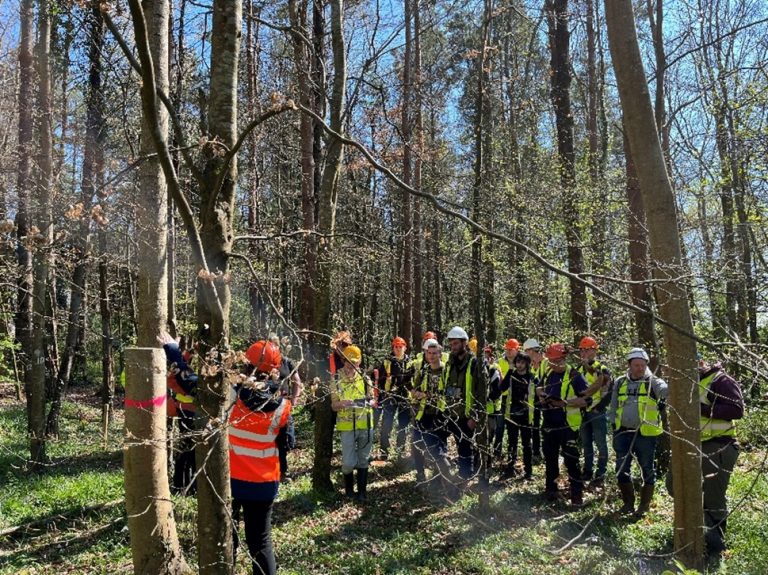
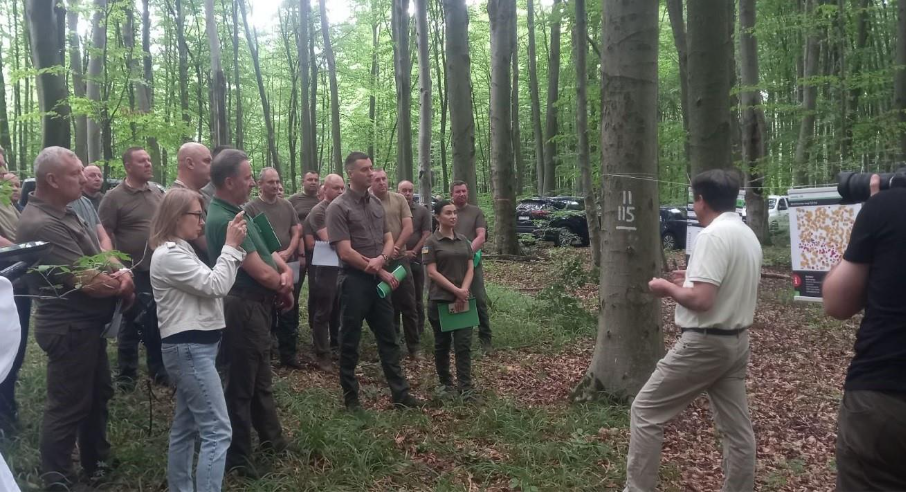
Between August and October 2025, experts organized practical seminars at the marteloscopes for staff from the state forestry enterprise “Forests of Ukraine.” Leading personnel from the Carpathian Forest Office described the exercises as highly useful and expressed their intention to continue this type of training in the coming years as part of their close-to-nature forestry strategy.

According to the Ukrainian government’s resolution no. 441 from 19 April 2024, clear-cutting in the Carpathian mountain forests has been prohibited. Instead, conversion cuttings are to be used – techniques that marteloscopes are particularly well-suited to practice.
Looking ahead, Prof. Lavnyy plans to offer courses for senior foresters from forestry enterprises around Lviv in spring 2026, with the goal of teaching them how to use the EFI training software and train future forest trainers (“train the trainers”). The marteloscopes will also be used for practical exercises by bachelor’s and master’s students, especially during their silviculture internships.
Thanks to numerous lectures by Prof. Lavnyy and his colleagues at other universities and national parks, and to their publications, the potential of marteloscopes in Ukraine is now well known. Colleagues from Kyiv, Zhytomyr, Ivano-Frankivsk, and Uzhhorod are planning to establish marteloscopes in their regions as well to support the education of students and foresters.
About the authors:
Vasyl Lavnyy is Vice-Rector for Research at the National Forestry University of Ukraine in Lviv, Dr. habil.; 103 General Chuprynka st., Lviv, 79057, Ukraine; lavnyy@gmail.com
Peter Spathelf is Professor of Applied Silviculture, Eberswalde University for Sustainable Development; Schicklerstrasse 5, D-16225 Eberswalde, Germany; peter.spathelf@hnee.de